
At LGIS, we believe that education is not simply the acquisition of knowledge—it is the cultivation of curiosity, character, and confidence. Preparing your child for the LGIS School Entrance 2026 should be a journey filled with discovery, shared learning, and joy.
Our goal is not to test children but to understand their readiness—their grasp of basic concepts, their ability to express themselves, and their willingness to learn.
This guide outlines the academic focus (based on and slightly above the ICSE curriculum standard), along with the ethical and emotional development we encourage. It is written to help parents prepare their children for both the academic and value-based expectations of LGIS.
The LGIS Philosophy: Learning with Values and Vision
At LGIS, education goes beyond textbooks. It is a partnership between teachers, parents, and students—grounded in ethics, respect, and lifelong learning.
Our teachers nurture curiosity and confidence, guiding children to think independently, communicate clearly, and act responsibly. We encourage every student to respect teachers and classmates, show gratitude toward all who support them, and take pride in ethical conduct.
We believe that knowledge has meaning only when combined with character. That is why, at LGIS, we focus on both—academic excellence and ethical growth.
The Syllabus and Preparation Guidelines
The LGIS entrance interaction and assessment are aligned with the ICSE curriculum, but we encourage slightly higher conceptual understanding and communication skills to ensure children transition smoothly into our academic environment.
Below is an overview of the areas parents can focus on, based on the class level their child is seeking admission to.
For Nursery and Kindergarten Admissions
Focus: Early literacy, number sense, and social readiness.
English and Communication:
- Recognition and correct pronunciation of upper- and lower-case letters (A–Z, a–z)
- Understanding and using phonetic sounds (beginning and ending sounds)
- Vocabulary through stories and daily conversation
- Speaking simple sentences about self, family, and surroundings
- Picture reading and storytelling with expression
Mathematics:
- Number recognition and counting up to 100
- Number sequencing (before, after, between)
- Simple addition and subtraction with objects
- Recognizing 2D shapes and colors
- Concepts of patterns, size, and comparison (tall/short, heavy/light, etc.)
General Awareness:
- Knowledge of common fruits, vegetables, animals, and birds
- Seasons, days of the week, and basic hygiene habits
- My school, my family, and my neighborhood
- Good manners and sharing habits
Preparation Tip:
Use storytelling, number games, and real-life conversations to teach. Encourage polite behavior and curiosity—children learn best when they feel respected and secure.
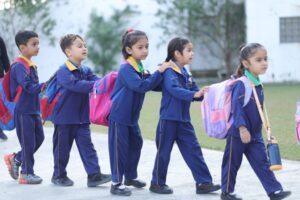
For Classes 1 to 3 (Lower Primary Section)
Focus: Building a solid foundation in reading, writing, comprehension, and problem-solving.
English:
- Reading short stories and answering “who, what, why” questions
- Use of punctuation, capital letters, and correct sentence structure
- Basic grammar: nouns, pronouns, verbs, adjectives, and prepositions
- Picture and paragraph composition
- Spelling practice and neat handwriting
- Recitation and short speech practice for confidence
Mathematics:
- Numbers up to 10,000 (Class 1: up to 1,000; Class 2: up to 5,000; Class 3: up to 10,000)
- Addition, subtraction, multiplication, and simple division
- Tables up to 10 (by Class 3, up to 15)
- Word problems using real-life examples
- Measurement, money, and time concepts
- Basic geometry (shapes, lines, corners)
Hindi:
- Reading fluency of simple passages and poems
- Word formation using स्वर and व्यंजन
- Basic grammar: लिंग, वचन, क्रिया, संज्ञा
- Picture-based writing and short paragraph writing
- Oral recitation and storytelling
Environmental Studies (EVS):
- Living and non-living things
- Food, clothes, shelter, and community helpers
- Festivals, good manners, and personal hygiene
- Weather, seasons, and environment awareness
- My country and its symbols (flag, anthem, etc.)
Preparation Tip:
Encourage your child to read aloud daily, narrate short stories, and explain basic concepts in their own words. Focus on reasoning, not rote learning.
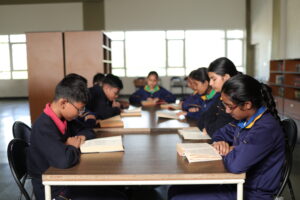
For Classes 4 to 6 (Upper Primary Section)
Focus: Strengthening conceptual understanding, logical reasoning, and expressive skills.
English:
- Reading comprehension with inference-based and vocabulary questions
- Grammar: tenses, prepositions, conjunctions, articles, and degrees of comparison
- Writing: paragraphs, informal and formal letters, short essays
- Picture composition and creative writing
- Word meanings, synonyms, and antonyms
- Public speaking and storytelling for expression
Mathematics:
- Place value up to 6-digit numbers
- Four operations (addition, subtraction, multiplication, division)
- Fractions, decimals, and simple percentages
- Perimeter and area of rectangles and squares
- Simple data handling and pictographs
- Introduction to geometry (lines, angles, triangles)
- Mental math and reasoning puzzles
Hindi:
- Reading comprehension with short answers
- Grammar: समास, कारक, काल, संज्ञा, सर्वनाम, विशेषण
- Short essays, letters, and paragraph writing
- Dictation and vocabulary building
- Recitation and conversation practice
Science:
- Plants: parts, functions, and photosynthesis
- Human body systems (digestive, respiratory, skeletal)
- Air, water, soil, and pollution
- Energy sources and simple experiments
- Safety and first aid awareness
Social Studies:
- India: states, capitals, and national symbols
- Map reading and directions
- Early civilizations and Indian freedom struggle
- Community and civic sense
- Awareness about current events and environment
Preparation Tip:
Promote inquiry-based learning. Ask your child to explain “why” and “how” things happen. Encourage them to express ideas clearly in both English and Hindi.
Ethics, Respect, and Character: The Core of LGIS Education
At LGIS, we believe that knowledge without ethics is incomplete. While academic excellence is important, our greatest focus is on helping children grow into honest, respectful, and compassionate individuals.
We guide children to:
- Speak respectfully to teachers, elders, and peers.
- Show gratitude to school staff and helpers.
- Display kindness, fairness, and teamwork.
- Take responsibility for their actions and words.
Parents can reinforce these values at home by modeling politeness and appreciation. Children who learn to value respect develop humility and grace—qualities that make them lifelong learners and good citizens.
The Importance of Handwriting and Presentation
- Good handwriting reflects focus, effort, and self-discipline. Encourage your child to:
- Write slowly and neatly, maintaining consistent size and spacing.
- Use correct punctuation and capitalization.
- Keep notebooks clean and organized.
- Take pride in presentation — it builds confidence and a love for learning.
At LGIS, children are appreciated not only for correct answers but also for neat, careful, and thoughtful work.
Confidence During the Entrance Interaction
Our entrance sessions are designed to be warm, conversational, and stress-free. Teachers may engage children in:
- Reading a short passage
- Describing a picture or object
- Solving simple math questions
- Telling a short story or answering general questions
Tips for Parents:
- Encourage your child to speak clearly and maintain eye contact.
- Practice introductions (“My name is…” and “I like to…”).
- Appreciate every effort, not just correctness.
- Teach them to greet teachers politely and listen attentively.
Remember—confidence comes from comfort and trust, not memorization.